
Claude Code benchmark · September 18, 2026
Research results in less time, with 93% fewer tokens
We ran the same research tasks through Dativue and through Claude in Chrome. Here are the prompts, measurements, answers we could verify, and the limits of the experiment.
fewer processed tokens
lower reported AI cost
Aggregate of three paired workflows. “Processed tokens” is calculated from the input, output, cache-read, and cache-write tokens reported by Claude Code. Results vary by task.
Methodology
A simple, paired test
Each paired case started in a fresh Claude Code session with the same model and research objective. One session could use Dativue but not Chrome. The other could use Chrome but not Dativue, WebSearch, WebFetch, Bash, or prior knowledge.
Same objective
The paired prompts requested the same sources, scope, fields, and output structure.
Fresh sessions
Each run started independently to avoid conversation history influencing the result.
Measured in Claude
Time, request count, tokens, and API-equivalent cost came from Claude Code’s usage panel.
Credits kept separate
Dativue credits are reported separately from Claude’s estimated model cost.
Aggregate result
Three paired workflows, one consistent pattern
Dativue reduced browser operation, model turns, token processing, and elapsed time in every completed comparison.
| Measured metric | Dativue | Browser | Calculated result |
|---|---|---|---|
| Visible completion time | 4m 16s | 16m 27s | 3.9× faster |
| API duration | 3m 08s | 11m 56s | 74% shorter |
| Claude-reported cost | $0.9564 | $7.3633 | 87% lower |
| AI requests | 26 | 188 | 86% fewer |
| Generated Sonnet tokens | 16.1k | 56.4k | 71% fewer |
| Approx. processed tokens | 1.84M | 27.99M | 93% fewer |
Case studies
What happened in each workflow
The aggregate hides meaningful differences. Chart extraction, a single SERP, and multi-video transcript research create very different amounts of browser work.
01 · Search trends
Comparing six months of Google Trends data
Claude compared three AI research terms, calculated direction, and separated measured relative interest from interpretation.
2 measured credits| Measured metric | Dativue | Browser | Calculated result |
|---|---|---|---|
| Visible completion time | 30s | 2m 58s | 5.9× faster |
| API duration | 30s | 2m 29s | 80% shorter |
| Claude-reported cost | $0.2535 | $0.55 | 54% lower |
| AI requests | 5 | 16 | 69% fewer |
| Generated Sonnet tokens | 1.9k | 12.2k | 84% fewer |
| Approx. processed tokens | 380k | 1.17M | 67% fewer |
What the numbers show
Both answers reached the same decision-level conclusion: “AI research tools” led the comparison, all three terms spiked around June and early July, and the final-period values were roughly 90% below the opening window.
Answer-quality note
The browser answer provided more month-by-month detail. Dativue explicitly surfaced missing-data periods, separated returned measurements from derived direction, and included a verification URL.

Read the prompts used in this test+
With Dativue
Quote one search_keyword_trends call with research_credit_quote.

Compare these terms in the United States over the previous six months:
- AI research tools
- AI research assistant
- deep research AI

Explain that values are relative interest rather than search volume, and separate the measured series from calculated direction and interpretation. Use only Dativue for the research.
With Chrome
Use Google Trends through Chrome to compare these terms in the United States over the previous six months:
- AI research tools
- AI research assistant
- deep research AI

Explain that Google Trends values represent relative interest rather than search volume. Separate measured series and observations, calculated direction, and interpretation. Use only data collected from Google Trends.
02 · Live search results
Inspecting the top 10 Google results
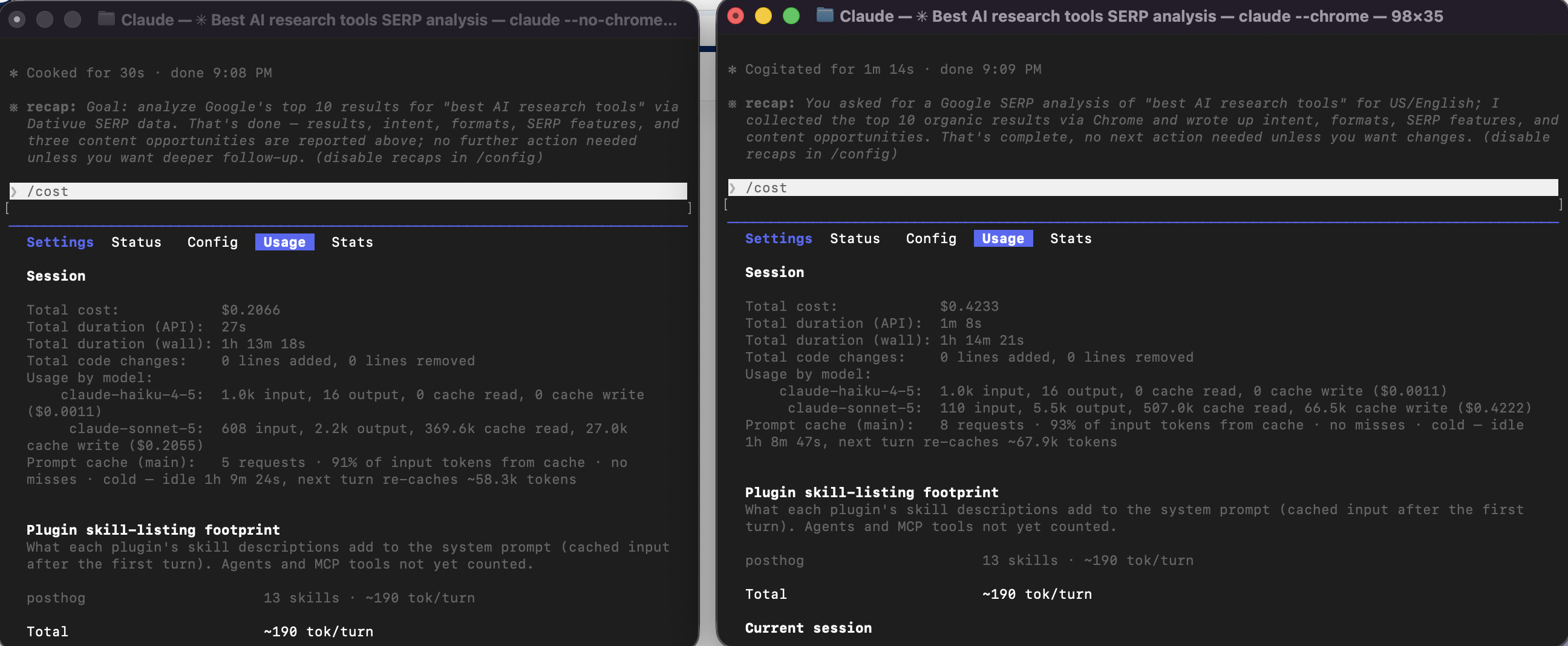
Claude collected the current organic results for “best AI research tools” and analyzed intent, page formats, SERP features, and content opportunities.
1 measured credit| Measured metric | Dativue | Browser | Calculated result |
|---|---|---|---|
| Visible completion time | 30s | 1m 14s | 2.5× faster |
| API duration | 27s | 1m 08s | 60% shorter |
| Claude-reported cost | $0.2066 | $0.4233 | 51% lower |
| AI requests | 5 | 8 | 38% fewer |
| Generated Sonnet tokens | 2.2k | 5.5k | 60% fewer |
| Approx. processed tokens | 400k | 580k | 31% fewer |
What the numbers show
Both sessions reported completing the requested top-10 organic result analysis. The smaller gap reflects a simpler browser task: reading one results page requires less navigation than extracting a chart or multiple transcripts.
Answer-quality note
The measurement record captured completion and usage, but not both full final answers. This case supports the efficiency comparison; it is not used as evidence that one answer was more accurate.
Read the prompts used in this test+
With Dativue
Quote one search_serp call with research_credit_quote.

Inspect the current top 10 Google results in the United States, in English, for “best AI research tools”. Report position, title, domain, and page type. Then identify dominant intent, recurring page formats, visible SERP features, and three realistic content opportunities. Separate measured results from interpretation. Use only Dativue.
With Chrome
Use Google Search through Chrome to inspect the current US English results for “best AI research tools”. Record the first 10 organic results and exclude ads. Report position, title, domain, and page type. Then identify dominant intent, recurring page formats, visible SERP features, and three realistic content opportunities. Use only Chrome.
03 · Video research
Analyzing three YouTube transcripts
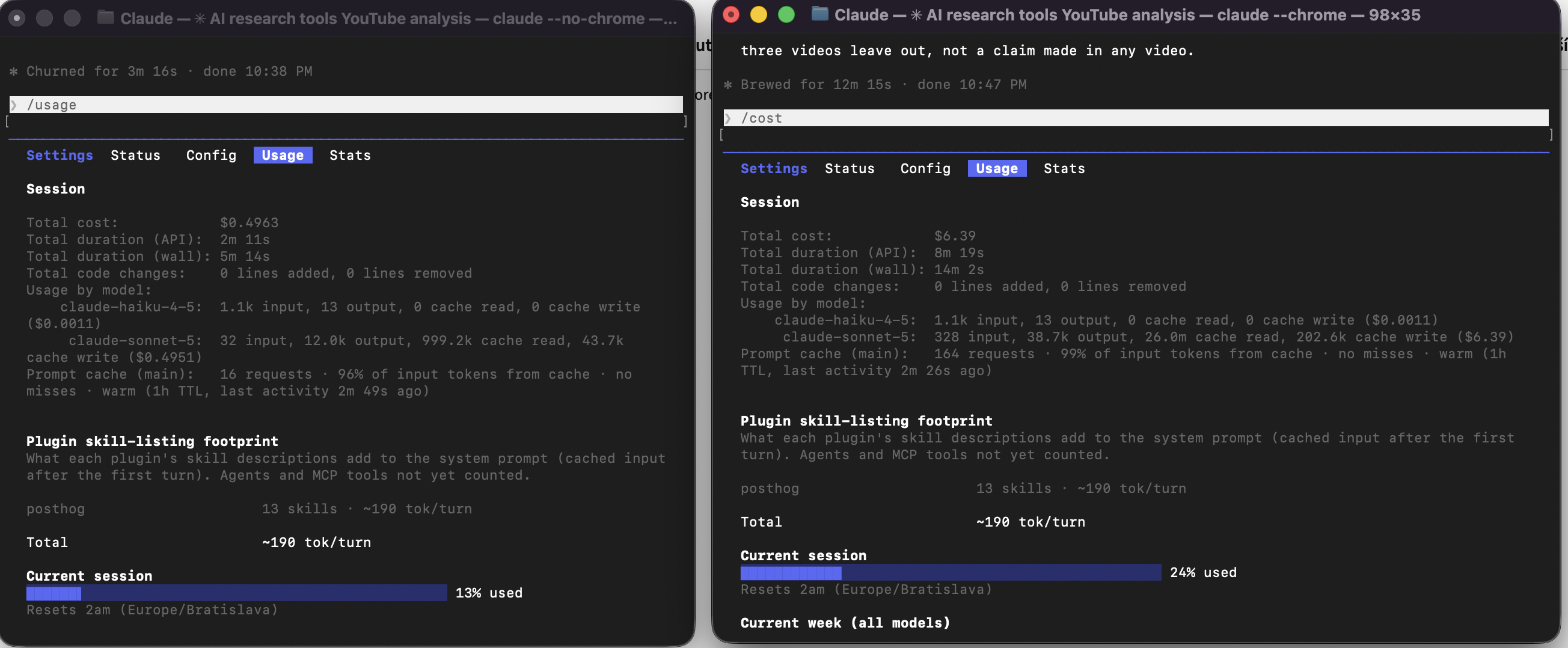
Claude searched for recent AI research-tool videos, selected three with transcripts, and compared recommendations, workflows, limitations, and content gaps.
9 calculated credits| Measured metric | Dativue | Browser | Calculated result |
|---|---|---|---|
| Visible completion time | 3m 16s | 12m 15s | 3.75× faster |
| API duration | 2m 11s | 8m 19s | 74% shorter |
| Claude-reported cost | $0.4963 | $6.39 | 92% lower |
| AI requests | 16 | 164 | 90% fewer |
| Generated Sonnet tokens | 12.0k | 38.7k | 69% fewer |
| Approx. processed tokens | 1.06M | 26.24M | 96% fewer |
What the numbers show
Browser navigation dominated the workload. Claude needed 164 model requests to search YouTube, open videos, expose transcript interfaces, extract evidence, and return to the analysis. Dativue completed the workflow in 16 requests.
Answer-quality note
Both sessions reported completing the requested three-video transcript analysis. The full answers were not independently scored, so this case supports the measured efficiency claim rather than a claim of superior answer quality.
Read the prompts used in this test+
With Dativue
Quote the complete planned workflow with research_credit_quote before making paid calls.

Search YouTube for English-language videos published during the previous 12 months about “AI research tools”. Select three relevant videos with usable transcripts and analyze them. Report video metadata, recommended tools, recurring workflows, limitations, shared claims, and three content opportunities. Support findings with short transcript excerpts. Use only Dativue.
With Chrome
Use YouTube through Chrome to search for English-language videos published during the previous 12 months about “AI research tools”. Select three relevant videos with accessible transcripts and inspect each transcript. Report video metadata, recommended tools, recurring workflows, limitations, shared claims, and three content opportunities. Support findings with short transcript excerpts. Use only Chrome.
04 · Accessibility case
Researching Reddit when browser access was blocked
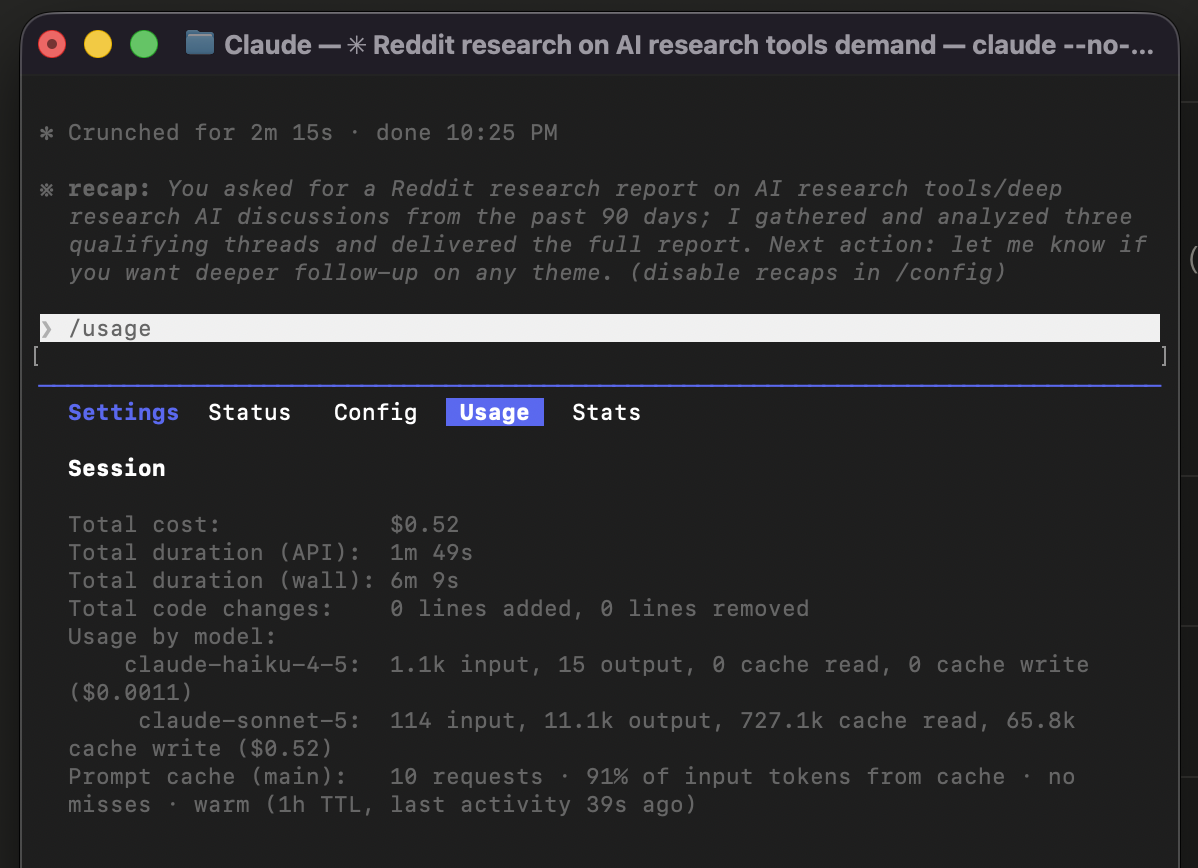
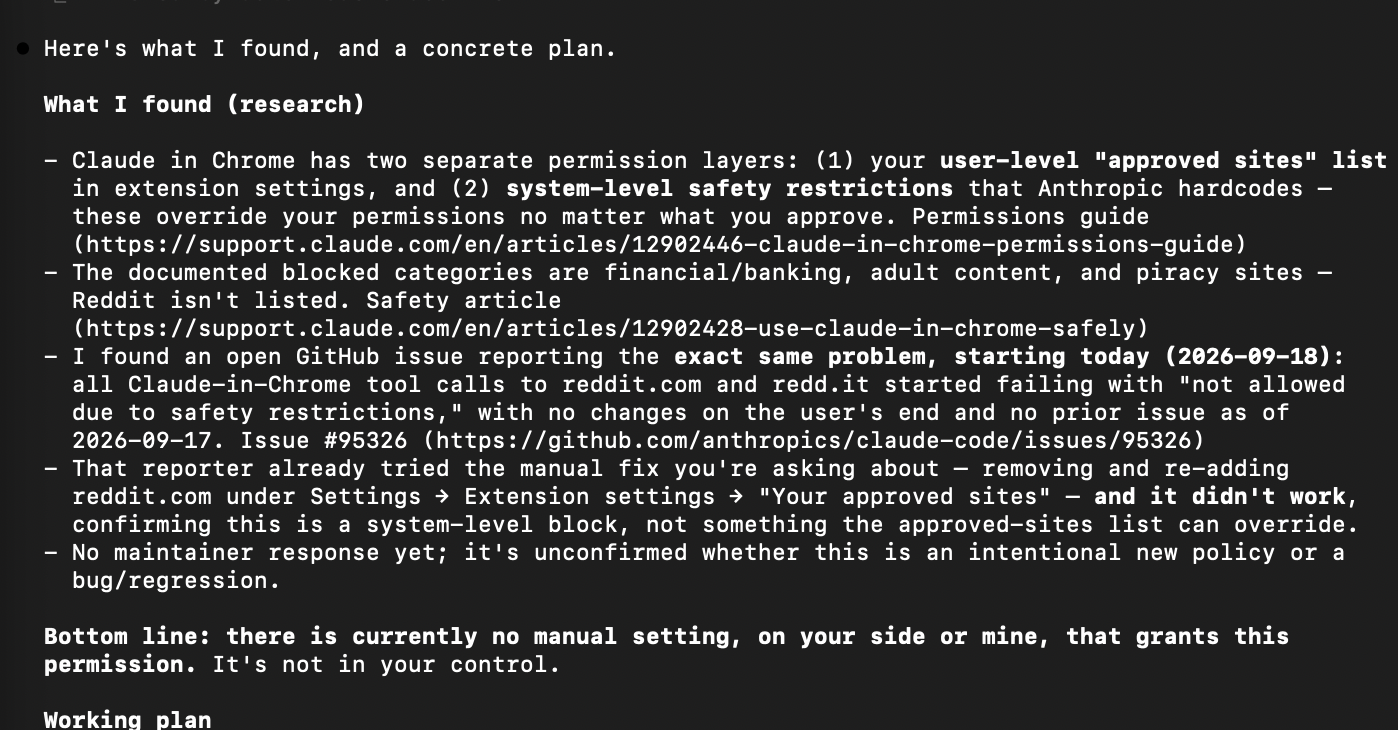
Claude in Chrome stopped before collecting data because Anthropic’s browser safety layer blocked Reddit access. Dativue completed the three-thread public-comment analysis.
7 calculated credits| Measured metric | Dativue | Browser |
|---|---|---|
| Visible completion time | 2m 15s | Blocked before collection |
| API duration | 1m 49s | Blocked before collection |
| Claude-reported cost | $0.52 | Blocked before collection |
| AI requests | 10 | Blocked before collection |
| Approx. processed tokens | 805k | Blocked before collection |
What happened
Dativue searched public Reddit data, selected three relevant discussions, retrieved comments, and produced the requested evidence summary.
Why there is no comparison
This is an accessibility case, not a speed comparison. The browser restriction was observed on September 18, 2026 and may change.
Read the Reddit research prompt+
Quote the complete planned workflow with research_credit_quote before making paid calls.

Search public Reddit content from the previous 90 days for discussions about “AI research tools” or “deep research AI”. Select three relevant threads with meaningful discussion and retrieve up to 20 public comments or replies from each. Report recurring jobs, complaints, requested features, representative language, and evidence counts. Separate collected evidence from interpretation.
What Dativue changes
Faster research. Fewer tokens. Lower cost.
Dativue gives your AI structured, source-linked evidence directly, reducing the time and model work spent navigating websites.
Faster results
4m 16s with Dativue versus 16m 27s through the browser.
Fewer tokens
1.84M processed tokens versus 27.99M across the same workflows.
Lower AI cost
$0.96 versus $7.36 in Claude-reported usage cost.
Fewer AI requests
26 model requests versus 188 to complete the workflows.
Aggregate of three paired Claude Code workflows covering Google Trends, live search results, and YouTube transcript research. Results vary by task.
Give your AI better research data
Connect Dativue and research search demand, customers, competitors, and trends from the AI you already use.
Connect your AI agent